A Risk-Based Integrity Management of CO₂ Pipelines in CCUS: Integration of Failure Mechanisms, Risk Assessment, and Inspection Strategies—A Review
DOI:
https://doi.org/10.59511/riestech.v4i4.167Keywords:
CO₂ pipeline, Carbon Capture, Utilization and Storage, Risk-Based Inspection, integrity management, Bayesian network, corrosion, fracture propagationAbstract
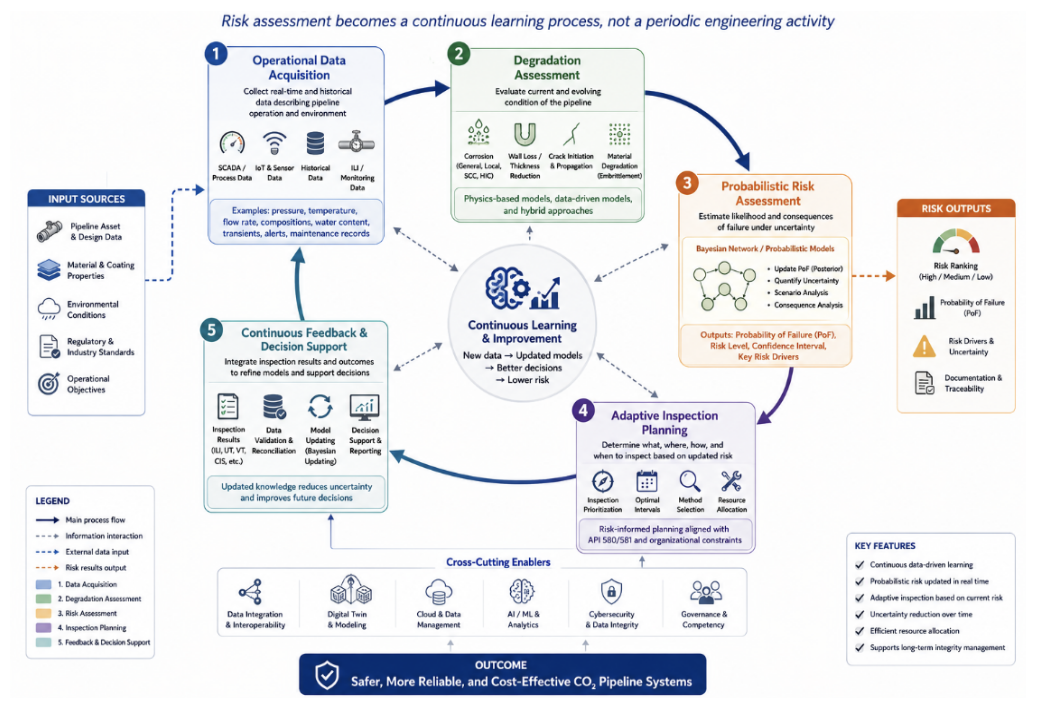
The accelerated deployment of Carbon Capture, Utilization, and Storage (CCUS) systems requires safe and reliable CO₂ transportation infrastructure. Pipelines remain the most feasible option for large-scale CO₂ transport; however, dense-phase thermodynamics, impurity interactions, decompression behavior, and environmentally assisted degradation create integrity challenges that differ from those of conventional hydrocarbon pipelines. This review examines how failure mechanisms, risk assessment methods, and inspection strategies can be integrated into a Risk-Based Inspection (RBI) framework for CO₂ pipelines. Literature was synthesized from studies indexed in Scopus and Web of Science, with emphasis on corrosion, fracture propagation, probabilistic risk assessment, monitoring technologies, and inspection planning. The reviewed evidence indicates that corrosion-related degradation and running fracture are the most critical threats, while probabilistic and reliability-based approaches are increasingly used to address uncertainty. Nevertheless, integration between degradation assessment, risk modeling, and inspection optimization remains fragmented. This paper proposes a dynamic RBI concept that links CO₂-specific degradation mechanisms, Bayesian risk updating, real-time monitoring, and adaptive inspection scheduling. The proposed synthesis supports more reliable, risk-informed integrity management for future CCUS pipeline networks.
Downloads