A Review on Strengthening Asset Integrity Management through Risk-Based Inspection In Hydrocarbon Piping Systems
DOI:
https://doi.org/10.59511/riestech.v4i3.161Keywords:
Asset Integrity Management, Corrosion Assessment, Hydrocarbon piping, remaining life, Risk Based Inspection, risk rankingAbstract
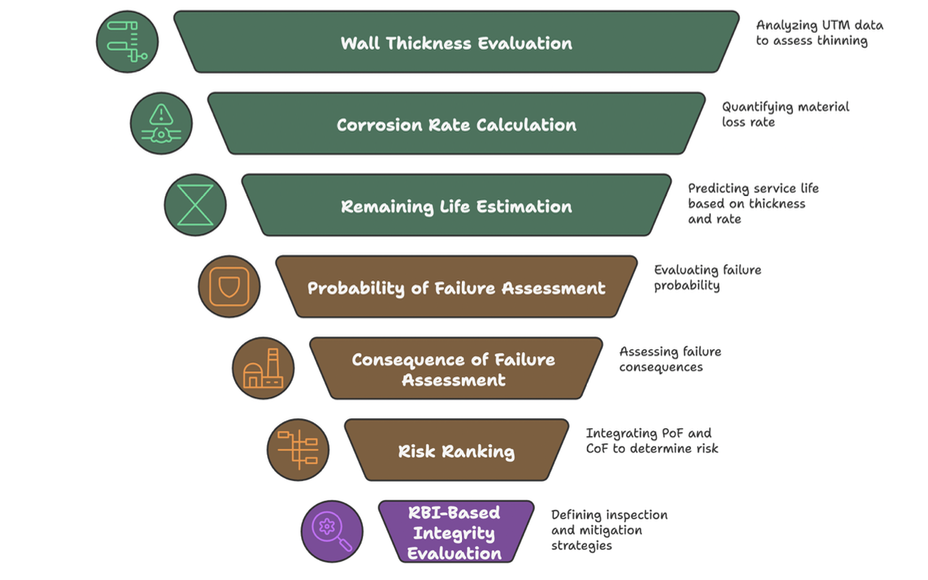
Hydrocarbon piping systems are critical assets in oil and gas facilities because they operate under pressure, temperature, fluid variability, and corrosive environments that can accelerate material degradation. This study develops a risk-based integrity evaluation framework for hydrocarbon piping systems by integrating corrosion rate assessment, remaining life estimation, and Risk-Based Inspection (RBI) prioritization within an Asset Integrity Management (AIM) perspective. A quantitative case study was conducted using 2025 inspection data from hydrocarbon and utility piping systems at PT X. The evaluation followed the principles of API RP 580 and API RP 581 and used ultrasonic thickness measurement, actual wall thickness, minimum required thickness, corrosion rate, remaining life, Probability of Failure (PoF), Consequence of Failure (CoF), and risk ranking. The results show that most piping systems were categorized as Very Low Risk, while several lines remained in the Medium Risk category. Utility Water Piping had the highest corrosion rate of 0.253 mmpy and the shortest remaining life of 8 years. Hydrocarbon Gas Piping had a lower corrosion rate of 0.076 mmpy and a remaining life of 38 years. The proposed framework strengthens inspection prioritization, risk-based maintenance, and long-term AIM implementation.
Downloads