Auditing Physical Consistency in Engine Fault Detection Using Domain-Informed Monotonic XGBoost and Explainable Boosting Machine
DOI:
https://doi.org/10.59511/riestech.v4i4.180Keywords:
engine fault detection, physical consistency, monotonic constraints, explainable boosting machine, SHAP, label validityAbstract
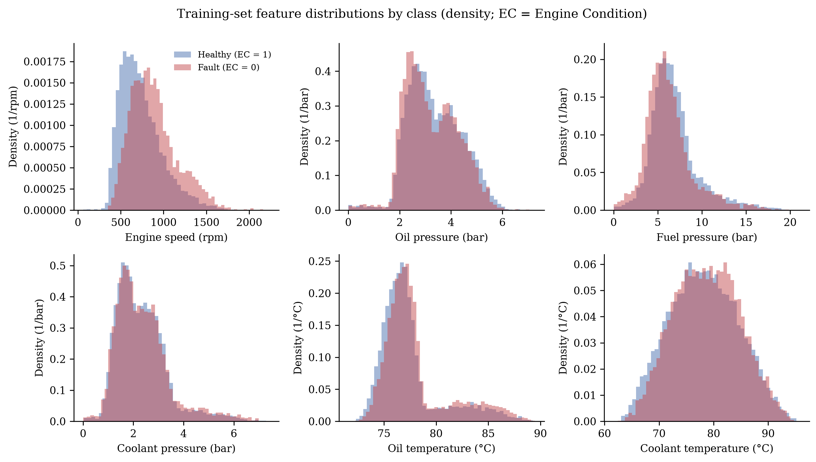
Machine-learning models for engine fault detection are usually judged by predictive accuracy, although a model can score well while learning relationships that contradict engine physics. This study proposes a physical-consistency audit that combines domain-informed monotonic constraints in XGBoost with the glass-box Explainable Boosting Machine (EBM). Using a public dataset of 19,533 engine records with six sensor variables, seven classifiers were benchmarked under a leakage-safe protocol with a stratified hold-out test set, inner-cross-validated tuning, repeated cross-validation and out-of-fold threshold selection. Three XGBoost configurations with identical hyper-parameters (unconstrained, domain-constrained and reverse-constrained) were then compared. The boosting models performed statistically alike, with EBM the best (test ROC-AUC 0.701). Imposing engineering-consistent constraints significantly reduced ROC-AUC (−0.016 on the test set; 95% CI −0.023 to −0.009) and removed almost all attribution to oil pressure and oil temperature, whereas reversed constraints had no cost. SHAP and EBM shape functions independently showed all three constrained sensors acting opposite to expectation, and semi-synthetic experiments with known physics reproduced this signature only when labels were inverted. The audit therefore exposes physically implausible learning and flags possible label inversion without expert relabelling.
Downloads