Optimization of Fork Tines Design on a 3-Ton Capacity Forklift Using Heel Radius and Thickness Geometry Variation via Finite Element Analysis
DOI:
https://doi.org/10.59511/riestech.v4i3.179Keywords:
Forklift, Fork Tines, Finite Element Analysis, Taguchi Method, AISI 4140Abstract
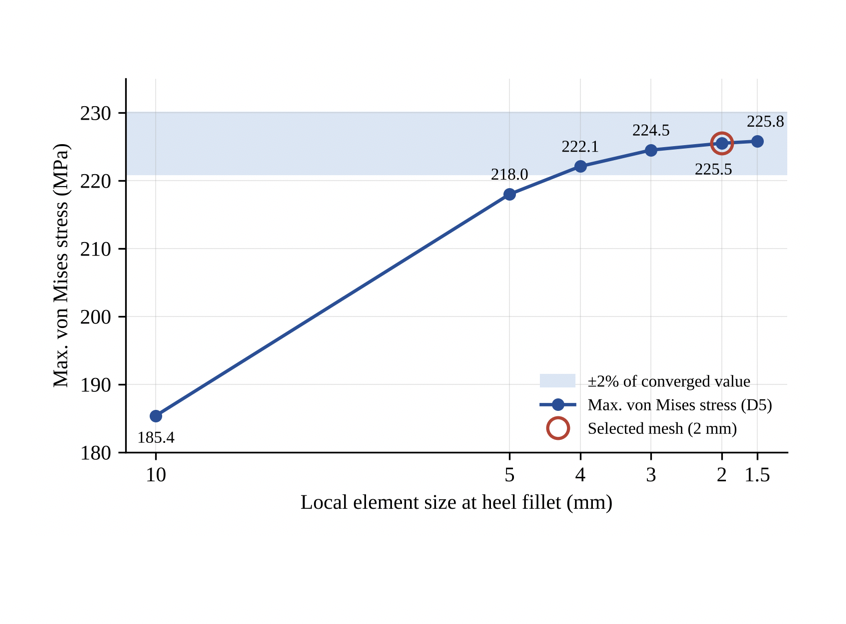
Structural failure at the heel area of forklift fork tines due to high stress concentration is a serious safety concern in the logistics industry. This study aims to optimize the geometry of ISO Class 3 fork tines with a 3-ton capacity to achieve a design with maximum strength and efficient mass. The design methodology utilizes a 3² factorial design via the Taguchi approach (L9 orthogonal array) by varying the Heel Radius (65, 75, 85 mm) and Base Thickness (40, 50, 60 mm). Testing was performed numerically through static Finite Element Analysis (FEA) on AISI 4140 Alloy Steel, assuming a uniform load of 15,000 N per fork arm at a Load Center distance of 500 mm. Initial validation of the numerical model against analytical cantilever-beam calculations resulted in an error below 1%, confirming simulation accuracy. ANOVA results prove that base thickness is the primary and most dominant parameter significantly affecting stress (P-value 0.003 < 0.05). Through comparative analysis, Design 6 (D6), combining an 85 mm Heel Radius and 50 mm Thickness, was selected as the most optimal configuration, reducing maximum stress to 208.5 MPa and increasing the Factor of Safety (FoS) to 1.99, significantly safer than the factory-standard design (FoS 1.84) while maintaining a mass efficiency of 97 kg. The optimized AISI 4140 design is structurally safe for static operation and is recommended as a fabrication standard.
Downloads