Design of a Heavy-Duty Manual Turntable for Heavy Material Handling Activities to Reduce the Potential Risk of Musculoskeletal Disorders (MSDs)
DOI:
https://doi.org/10.59511/riestech.v4i3.154Keywords:
Ergonomics, RULA, MSDs, Rotary TurntableAbstract
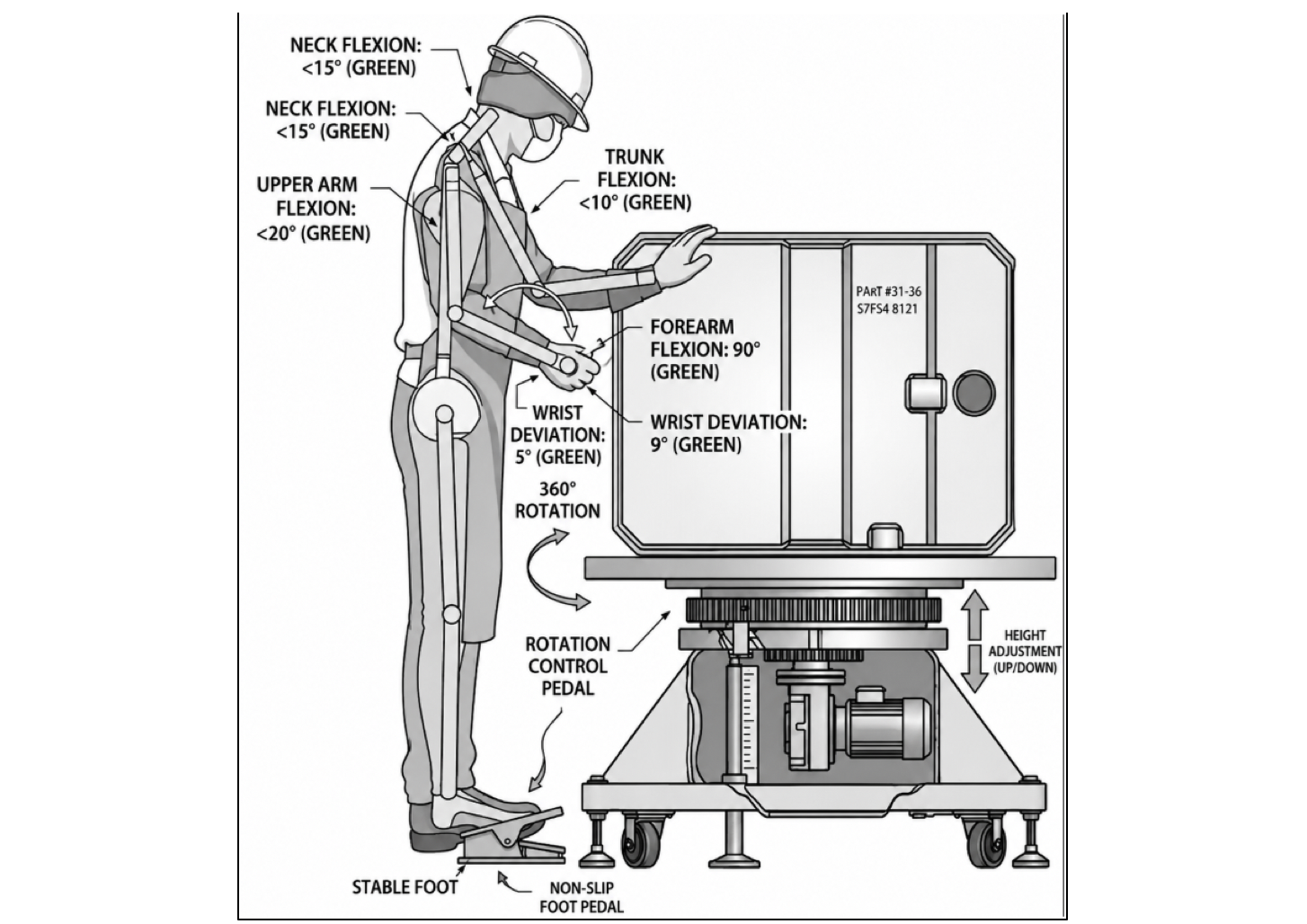
Heavy material handling and rotation activities in the fabrication area are still performed manually using a conventional worktable without a material rotation system. This condition requires the observed operator to bend, twist the body, and repeatedly lift and reposition the material during the work process. These non-neutral working postures have the potential to cause Musculoskeletal Disorders (MSDs), particularly in the neck, shoulders, lower back, arms, and wrists due to excessive and repetitive physical loading. Therefore, this study aims to analyze ergonomic risks in heavy material handling activities and design a Heavy-Duty Manual Turntable to improve operator working posture. The methods used include field observation, work posture documentation, Nordic Body Map (NBM) analysis, posture angle measurement, ergonomic evaluation using Rapid Upper Limb Assessment (RULA) and Rapid Entire Body Assessment (REBA), anthropometric analysis, CAD-based design simulation, and simple biomechanical analysis. The NBM screening was completed by one observed operator and identified complaints in the neck, shoulders, lower back, upper arms, wrists, and lower legs. The initial condition had a RULA score of 6–7 and a REBA score of 9–11. The proposed solution is a Heavy-Duty Manual Turntable Model VP1-R with 360° rotational capability and an adjustable working height. Based on the proposed posture simulation, the estimated RULA score decreased to 2–3 and the estimated REBA score decreased to 2–3. The simplified biomechanical comparison also indicated an approximately 45% reduction in the lower-back moment. Because the post-design assessment was based on CAD simulation and not on a fabricated prototype, these results should be interpreted as preliminary design estimates. This study presents an ergonomic assistive-device design that can be used as a basis for prototype development and field testing.
Downloads